Text by Karen Carroll
Southern Home (SH): Who first encouraged your creative talents?
Leta Austin Foster (LAF): I was fortunate to grow up in Florida close to my grandmother, and I used to redecorate her house all the time in my mind. Now, looking back on it, I realize I would actually leave it exactly the way it was. Both she and the house were wonderful. She loved setting afternoon tea. And I can still picture her gardening in a printed chiffon dress, a double strand of pearls, and a big hat. She always knew exactly what and where she wanted things planted.
SH: We’re almost envisioning a Nancy Lancaster-like figure.
LAF: Funny you should say that, as my grandmother was Nancy Lancaster’s cousin and a Langhorne from Virginia. I never met Nancy, but I admire her tremendously.

SH: Do you consider Lancaster to be an influence in your work? We can spot a nod to English country house style in some of your rooms.
LAF: Well, I did intern with Colefax and Fowler and the great Imogen Taylor in my younger days, but I probably have drawn more inspiration from Parish-Hadley. A few years ago, there was a published illustrated family tree of American decorators. It starts off at the trunk with legends such as Ruby Ross Wood and Elsie de Wolfe, then it branches into Albert Hadley and Sister Parish and such, and then other decorators leaf out from there. I’m a leaf on the Sister Parish branch.
SH: Sounds like both your family trees—the real one and the imagined—are pretty fine company to be in. How would you describe your own aesthetic today?
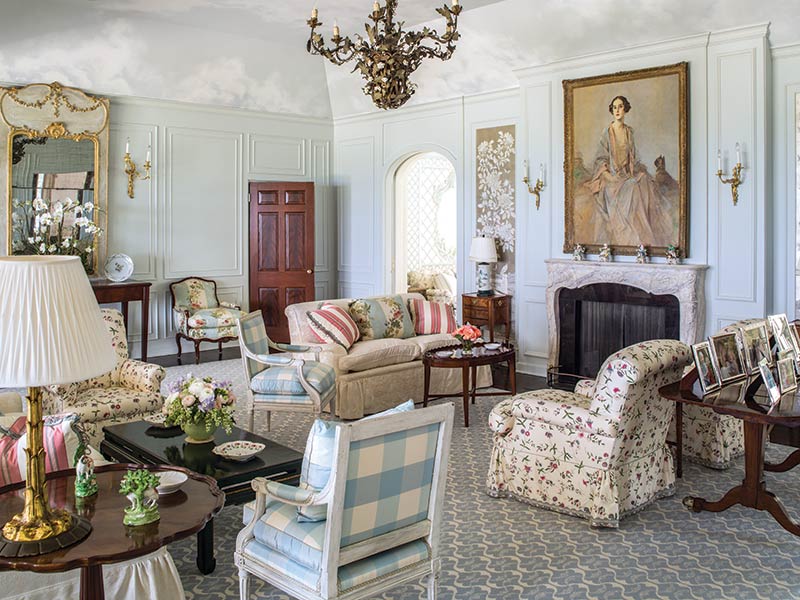
LAF: That’s always a bit hard because, as a designer, you go where you’re hired. I’m hired so much for traditional work, but I think my style is more of a blend. You might call it transitional traditional—traditional redone for comfort. You could even say it’s modernism taken back for beauty. It would be hard for me to walk into a room done in all beige or gray and want to live there, although I can appreciate it. But if the only color I’m going to get is from a vase of flowers, then it’s just not for me.
SH: Let’s explore that subject of color since this is our color issue. Do you happen to have a favorite?
LAF: I love blue, but sometimes it’s more about what I’m feeling at that moment. What I don’t believe in is this “color of the year” business, unless it’s one you truly love. If you’re going to spend a lot of money on a room, the last thing you want to feel is that it will be out-of-date the next year.
SH: You have offices in New York and Palm Beach, and you have decorated many points in between. How does the environment influence your color choices?
LAF: Every project is an amalgam of the people who hired you, the architecture of the house they’ve either bought or built, and the location. Those three things have to influence what a house is going to look like. One of my earliest humbling lessons was when I brought back all these beautiful fabric samples after my internship. Once I got home, I realized none of them worked. London, with its soft gray light, made the colors glow. But in Florida, with our bright light, they looked drab and dirty. I learned you can’t just do a London townhouse in the middle of Palm Beach. Well you can, but it wouldn’t be very smart. Although I love highly glazed walls, and I might do them in deep, rich colors in New York, they don’t look right in Florida. The sun is so intense, and you end up not being able to see in the room—everything becomes a silhouette. I always have to think about where I am.

SH: How do you approach combining colors in a room?
LAF: I never want things to look matchy-matchy. I’m looking right now at some classic prints from Colefax, and one that I like so much is called “Amelie.” It has creams, whites, and shades of green on a natural background. There’s a time when I might have used it in a green or beige room, but where I think it would be fabulous is in a deep coral library. That’s when rooms are the prettiest, when they’re just a mélange of colors.

SH: It’s clear from many of your rooms that you’re also a big fan of wallpaper.
LAF: I absolutely love it. People call me the wallpaper queen! It’s where you get the biggest decorating bang for your buck. Think about it—you no longer have to have the antique screen or the big oil painting, although those items can look terrific against it as well. Wallpaper makes a room so cozy and warm, even when it’s cool. It gives a room depth. And it can be way less expensive than doing some of the elaborate paint finishes.
SH: What are some of the smallest details that make or break a room for you?
LAF: Oh, I can think of quite a few. If you can believe it, I started my boutique 19 years ago because I could not find a good wastepaper basket, and I can spot a bad one from 50 feet away. I also hate when the plastic bag is looped over the top. I tell all my clients not to use plastic bags—put a doily in the bottom! Bed linens really matter to me. Fine French and Italian linens are probably the most important items in my shop right now. I also like a bench at the foot of the bed, but if you can’t have one because there’s not enough room, having something folded on the end of the bed gives it delineation. It’s also important to use the right lightbulbs. That may seem small, but it makes a difference. If the bulbs are too bright, they can ruin a room. If they’re too soft, you can’t see well. Three-way bulbs are a good thing. I mainly use 60-watt ones for the main light, but I have to have a 100-watt bulb to read—otherwise I’d go blind.
SH: It sounds like bedrooms play prominently in your decorating priorities.
LAF: I believe the bedroom is the most important room in the house. Where do you go whenever everything seems against you? You go lie on your bed. I’ll almost never do a contemporary one. People need to have pretty things around them that make them feel really good. I confess that I’m also a voracious reader, and I tend to read lying down, so I often head straight to my bedroom after dinner.

SH: Given that you love a good book, if you could decorate a house for any fictional character, who would it be?
LAF: Hmmm. Even though she was awful and selfish, Daisy Buchanan of The Great Gatsby comes to mind. There are moments when she’s reminiscing about when she was young—people coming in from the dances and throwing their dresses on a chair and kicking off their little sparkly shoes—and somehow I just see those dim rooms and how pretty they must have been. I’d love to do a house like that. Or maybe a composite of Twelve Oaks or Tara in Gone with the Wind, or even the houses in one of my favorite books of all time, All the King’s Men. I find a grand Southern house that has kind of been left to molder so beautiful and mysterious. I’d certainly restore it, but I’d want to leave it looking just a little decrepit.
SH: Finally, what is the best advice you could give about developing a sense of style?
LAF: If you respect a certain person’s design and the way they live, go to that person and just listen. You’ll always learn more from other people, so don’t assume you know everything yourself. In a book I just finished (though it wasn’t a particularly good book, so I won’t recommend it), there is this one sentence that I just love: “Don’t believe everything you think.” Nothing could be truer.
For more colorful and captivating interiors, check out the issue below!